Nicola Carboni
Assistant Professor | Information School | University of Illinois at Urbana-Champaign

Hi, I’m Nicola Carboni, an Assistant Professor in the School of Information Sciences at the University of Illinois at Urbana-Champaign, where I direct the Encoding Culture(s) Lab.
My research sits at the intersection of documentation and computation, and my research integrates data science and knowledge representation to make heritage data more accessible and interpretable. Current projects include retrieval-augmented generation systems for querying cultural heritage knowledge graphs and development of data pipelines for the integration and analysis of art exhibition data. Earlier work explored image circulation through network science, semantic frameworks for documenting iconographic patterns in built heritage, and computational approaches to Burckhardt’s epistolary corpus. Before joining Illinois, I held positions as a Digital Humanities Fellow at the Villa I Tatti Harvard Center for Italian Renaissance Studies, Postdoctoral Researcher in Digital Humanities at the University of Geneva, and Research Fellow and Semantic Architect for the Swiss Art Research Infrastructure (SARI) at the University of Zurich. I completed my PhD in Engineering at NTUA (National Technical University of Athens), on the conceptualization and semantic description of digitized tangible and intangible content, in conjunction with the MAP Laboratory at CNRS, where I was previously appointed as a Marie Curie Early Stage Research Fellow.
If you are interested in working together, whether as an independent study student, a prospective PhD student, or a postdoctoral researcher, please visit the Encoding Culture(s) Lab website or reach out directly.
You can download my full CV here.
news
| Oct 23, 2025 | I will be presenting, the paper “Querying Art Historical Knowledge Graphs: a Natural Language Interface for Exploring CIDOC-CRM Data Using LLM” at the conference ‘Digital Publishing for Art History’ at the Bibliotheca Hertziana – Max Planck Institute for Art History, Rome, Italy. |
|---|---|
| Oct 07, 2025 | I will be presenting, the paper “AI and Knowledge Graphs: From Datafication to Accessibility” at the seminar ‘Cultural Heritage and AI’ at Leiden University, Leiden, Netherlands. |
| Sep 08, 2025 | I will be presenting, together with Matteo Romanello and Simon Gabay, the paper “Predicting the Fictional Time and Space of French Theatre Plays by Using Large Language Models” at the conference ‘IEEE International Conference on Cyber Humanities’ in Florence, Italy. Pre-print available here. |
| Apr 01, 2025 | I will be presenting “Integrating Computational and Historical Methods for Investigating Image Circulations” at the workshop ‘Encoding the Image: How does AI affect the Future of Photo History?’ at the Image Centre in Toronto. |
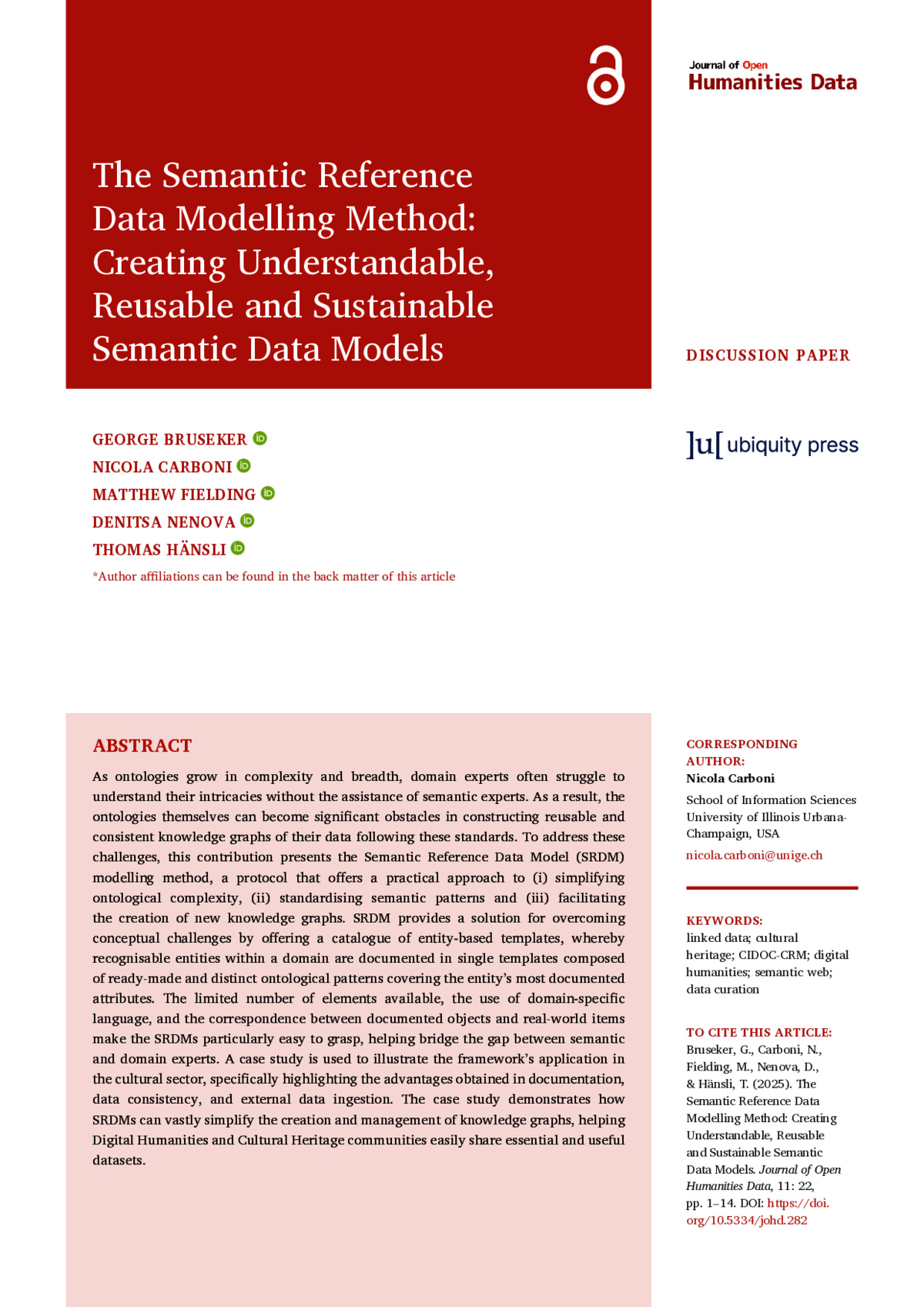
| Mar 12, 2025 | Just published on the Journal of Open Humanities Data: The Semantic Reference Data Modelling Method: Creating Understandable, Reusable and Sustainable Semantic Data Models. Available in Open Access here. |